Status
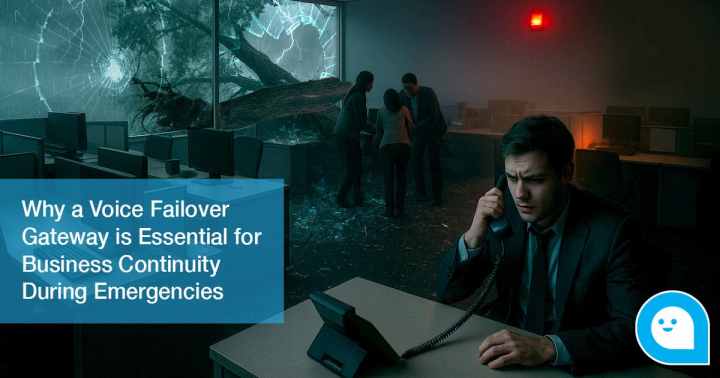

When your internet connection fails, so does your business. Whether it’s a fiber cut, power outage, cyberattack, or natural disaster, the result is the same: your communication channels go silent, your systems stop responding, and your employees are left scrambling. A voice failover gateway is your safety net , the technology that keeps your phone lines ringing, your voice applications online, and your teams connected when the primary network goes down.
Most businesses depend heavily on their network connection. But that connection is only as strong as the weakest link. A voice failover gateway detects when that link fails and instantly reroutes voice traffic to a backup connection, such as 4G or 5G LTE. The switch happens with minimal disruption, often in seconds. This isn’t just a tech upgrade. It’s a core part of keeping your operations moving and your people safe when the unexpected happens.
Connecting Failover to Emergency Planning
Failover gateways don’t exist in isolation. They support a broader emergency strategy, which should start with a documented Business Continuity Plan (BCP). A solid BCP identifies the functions your business can’t operate without (i.e.voice communication, online transactions, CRM access), and builds safeguards around them.
Connectivity usually ranks high on that list. With digital tools driving every department, even a short outage can delay orders, miss deadlines, or block emergency alerts. If your failover plan is weak or missing, the business risks more than just inconvenience. There’s lost revenue, damaged credibility, and in some industries, serious safety concerns.
Emergency planning also includes employee protection. OSHA recommends businesses have a clearly defined Emergency Action Plan (EAP), outlining what employees should do during various crisis scenarios. But communication is often the weakest point in these plans. What happens if your phone system or email goes down right when you need to reach your team?
This is where a voice failover gateway becomes more than a network solution. It supports your emergency reporting and notifications as well as your team’s ability to stay informed and coordinated during a crisis. Without it, even the best-laid emergency procedures can fall apart.
How Failover Works
Technically, a failover gateway monitors your primary network link and as soon as it detects an outage, it reroutes traffic to a secondary connection, often a cellular network. Once the primary link is stable again, the gateway switches back.
Advanced systems like ClearlyIP’s VoIP Failover Gateway go even further. They support up to 250 SIP devices, keep internal LAN traffic operational, and route emergency calls even if your main PBX is offline. With optional battery backup, they keep running even during power outages, extending their reach beyond simple connectivity.
Use Cases Across Industries
In hospitality, continuous service isn’t optional, internal and external voice communications all rely on a stable connection. When that connection drops, customer satisfaction drops with it. A voice failover gateway allows hotels and resorts to maintain essential services, route calls over a cellular backup, and keep systems like door locks and security phones functional until service is restored.
Education relies on real-time access. Teachers, students, and administrators all need consistent access to voice communications and safety alert systems. A failover gateway keeps the network active and ensures that both routine education and critical safety systems remain operational.
General businesses face similar challenges. Remote and hybrid teams often work in cloud-based environments. If the internet fails, so does their ability to do their jobs. Failover systems let business owners sleep at night knowing the operation won’t stall over a single point of failure.
Deployment and Considerations
Deploying a failover gateway is straightforward, but it’s not plug-and-play. The backup connection must be strong enough to handle your business traffic. Using multi-carrier SIMs and external antennas can improve reliability, especially in rural or high-traffic areas.
Security is another critical factor. Failover doesn’t mean leaving your backup path open to attacks. Your failover connection should be encrypted, isolated from public networks, and follow the same firewall and access control policies as your primary network.
Automatic failover and failback are recommended to reduce the risk of human error. Monitoring tools should alert you the moment a failover occurs, so your IT team can investigate. Periodic testing , including scheduled failover drills , ensures your backup path is ready when it matters.
Making It Part of Your Safety Strategy
For a failover gateway to truly support emergency readiness, it must be integrated into your overall response plan. That includes:
- Keeping your failover system powered during outages with a dedicated UPS battery system
- Linking it to voice systems that support emergency alerts or panic buttons
- Training your staff on what to expect during a failover event , from network behavior to who they should contact
For example, ClearlyIP’s VoIP Failover Gateway includes six analog ports that can connect directly to legacy phones, door systems, or emergency phones. Even if your cloud PBX is offline, staff can make and receive local or emergency calls. That’s not just a convenience. It’s a safety requirement in many sectors.
Key Considerations for Voice Failover Gateway Deployment
If you decide to use a voice failover gateway, here’s what to watch:
| Factor | Why It Matters | Best Practice |
| Secondary link quality | If cellular is weak, failover won’t help | Multi-carrier SIMs, external antennas |
| Automatic vs manual failover | Seamless switching reduces downtime | Use auto-failover and auto-failback when possible |
| Routing and policy logic | Some traffic may remain on primary path | Use traffic rules, QoS, routing policies |
| Security | Backup path must be secured | VPN, access control, firewall rules |
| Monitoring & alerts | You must know when failover happens | Log and alert on link failures and performance deviations |
| Testing & maintenance | Stale or untested failover is useless | Schedule periodic failover drills |
Summary (TLDR)
Business continuity isn’t just a checkbox. It’s a competitive advantage. When your competitors are down, staying online means you keep serving your customers, protecting your employees, and securing your reputation.
A voice failover gateway gives you that advantage. It buys you time when minutes matter, supports safety plans that protect lives, and keeps your business running even when everything else isn’t.