Status

For years, becoming a VoIP provider looked easy. Install an IP PBX. Connect SIP trunks. Put your logo on a portal. Start billing customers monthly.
Back in the early days of Asterisk and FreePBX®, that mindset exploded across the MSP and IT industry. Honestly, there was an inside joke for years that as soon as an MSP or IT guy installed FreePBX for the first time, they immediately thought they could become a carrier.
And to be fair, many absolutely did.
When our team built and managed those open-source projects, we enabled an entire generation of providers to enter the telecom market. That was part of what made the open-source telecom movement exciting. Smaller companies suddenly had access to technology capabilities that previously required massive investments and carrier-grade infrastructure.
At one point, mostly as a joke, I submitted a session proposal at an industry event titled: “How to Be the Next Vonage”. Before I could even pull the session down, more people had signed up for that talk than the session I was actually presenting.
That pretty much summed up the market at the time.
The industry was full of MSPs, hosting companies, integrators, IT providers, and entrepreneurs, all trying to build their own telecom business. And honestly, many built very successful companies.
But what most people underestimated was this:
Building the technology stack was the easy part. Operating a compliant telecom business over the long term became the hard part.
VoIP Compliance for MSPs Is No Longer Optional
Fast forward to 2026.
The telecom industry now faces aggressive FCC enforcement, robocall mitigation obligations, STIR/SHAKEN requirements, KYC expectations, telecom tax complexity, traceback requests, carrier audits, and growing cybersecurity expectations. Many MSPs entered telecom resale, assuming their upstream provider handled all of this.
That assumption has created many problems.
Recently, CommLaw Group published a client advisory discussing VoIP reseller compliance and MSP exit strategies, and the concerns they raised are very real. One of the biggest misconceptions in the telecom channel still sounds something like this:
“We’re just reselling somebody else’s platform.”
Regulators may not care nearly as much as people think.
In many cases, if you are billing the customer, it is your customer, your revenue, and potentially your compliance responsibility.
That is the part many MSPs and telecom resellers did not fully understand during the rise of white-label VoIP platforms.
Many companies assumed that because another provider owned the underlying infrastructure, compliance obligations would automatically remain with them as well. But from a regulatory perspective, things are often not that simple.
The White Label Telecom Problem Nobody Talks About
For years, the industry pushed the idea that anybody could “start their own phone company” simply by white-labeling another provider’s platform.
And technically, yes, you can.
You can brand invoices, set your own pricing, market yourself as a provider, and put your company name on everything the customer sees. But many companies misunderstood what that actually meant from a regulatory perspective.
A white-label platform does not automatically shield a reseller from FCC obligations, telecom taxes, robocall mitigation exposure, KYC expectations, traceback requests, state telecom rules, or liability exposure.
In many situations, regulators look at who sold the service, who owns the customer relationship, who assigned the numbers, who billed the customer, and who appears to be the provider, not simply whose switch processed the call.
A branded portal and a reseller agreement are not magical compliance force fields.
That realization has caught many smaller providers off guard over the last several years.
What Telecom Compliance Actually Includes
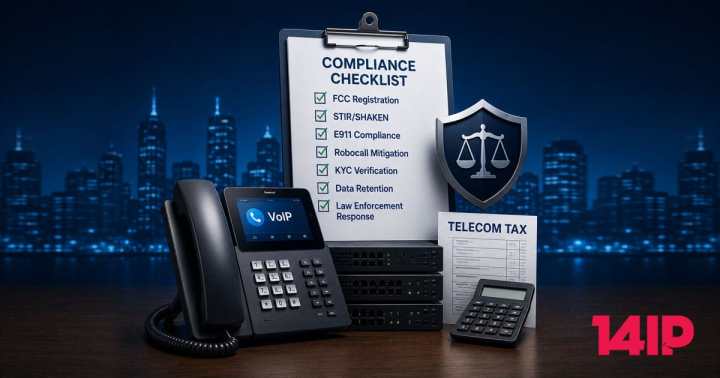
Depending on how your VoIP business is structured, telecom compliance may involve:
- FCC registrations
- USF contribution requirements
- telecom tax filings
- state telecom registrations
- E911 obligations
- STIR/SHAKEN requirements
- robocall mitigation filings
- customer KYC verification
- fraud prevention procedures
- law enforcement response processes
- data retention requirements
Unfortunately, many providers only discover these obligations after a carrier audit, traceback notice, robocall complaint, acquisition discussion, or legal review. That is usually not the ideal time to learn about compliance exposure.
The Operational Reality of Running a Telecom Company
The economics have also changed substantially.
Customers expect lower pricing, better uptime, SMS support, AI integrations, advanced analytics, cybersecurity protections, and 24/7 responsiveness.
At the same time, providers are facing shrinking margins, increasing compliance costs, fraud exposure, staffing challenges, and growing regulatory overhead. Many MSPs eventually realize they accidentally became telecom operators without fully intending to. And operating a regulated telecom business is very different than managing IT services.
What We’ve Seen Across the Industry
I’ve watched this shift happen across the telecom and open-source ecosystem for decades.
Some of the partners we supported 15 years ago through Asterisk and FreePBX built excellent telecom businesses with strong recurring revenue and loyal customer bases. But over time, many of those same providers started reevaluating the business. Not because they failed. Because the industry changed.
They loved serving customers, solving technical problems, building solutions, supporting deployments, and managing relationships. What they did not love was the growing pile of FCC filings, telecom taxes, traceback requests, compliance attorneys, fraud investigations, and constantly changing regulations that started consuming more and more of the business every year.
As the compliance burden grew, many providers started asking themselves an important question:
“Do we actually want to continue operating as a telecom carrier?”
For many, the answer eventually became “not really.”
Why Many MSPs Are Moving to the Agent Model
One of the biggest trends we are seeing now is MSPs and telecom resellers moving toward agent models, referral partnerships, and hybrid channel relationships rather than operating as fully independent telecom providers.
This allows many companies to maintain customer relationships and recurring revenue opportunities while reducing regulatory exposure and operational stress.
Ironically, many providers that originally wanted to “own their own telecom company” eventually discover they are happier making recurring revenue without being treated like a carrier by regulators.
That realization usually happens around the same time the compliance letters, traceback notices, attorney invoices, and tax registrations start piling up.
We work with many partners today operating successfully under both reseller and agent models. There is no universal right answer anymore. The right structure depends on your operational maturity, risk tolerance, staffing, long-term goals, and willingness to manage telecom compliance directly.
The Growing MSP Exit Strategy Conversation
Another major trend in the telecom industry is acquisition and consolidation.
Many providers have built meaningful telecom businesses over the last 10 to 20 years. Many of them still maintain valuable customer bases, strong monthly recurring revenue, and loyal long-term customers.
But they are also dealing with ownership fatigue, staffing challenges, compliance complexity, shrinking margins, and increasing liability exposure.
In many cases, those customer bases still hold strong value.
The mistake some providers make is waiting too long to evaluate strategic options. If compliance problems begin to stack up, they can negatively impact valuation, operational stability, customer confidence, carrier relationships, and acquisition opportunities.
Over the years, we’ve seen providers transition to agent models, merge with larger organizations, sell their customer bases, restructure operations, or exit the telecom business entirely.
Sometimes the smartest business decision is realizing you no longer want to operate the carrier side of the business directly.
There is nothing wrong with that.
Telecom Compliance Is Now a Business Risk Issue
Telecom compliance is no longer just back-office paperwork.
It now directly impacts:
- business valuation
- carrier relationships
- banking relationships
- messaging access
- insurance coverage
- customer onboarding
- acquisition opportunities
- operational risk
And in some cases, it determines whether a provider can continue operating at all.
That is why so many MSPs and telecom providers are reassessing their long-term strategy right now.
What Are Your Options?
At this point, most providers generally end up evaluating one of three paths.
- Fully Invest in Telecom Compliance
This means treating telecom as a core regulated business and investing accordingly in legal guidance, tax management, fraud prevention, compliance operations, and regulatory processes.
This can absolutely work, but it is no longer a side business. - Transition to an Agent or Partner Model
This allows MSPs to maintain customer relationships and recurring revenue opportunities while reducing regulatory burden and operational overhead. - Explore Acquisition or Exit Opportunities
For some providers, the smarter move is monetizing what they built while reducing future compliance exposure and operational stress.
The earlier those conversations happen, the more strategic flexibility usually exists.
Final Thoughts
The telecom industry has matured substantially over the last decade. The barrier to entry is higher. The compliance burden is heavier. The operational complexity keeps growing.
That does not mean there is no opportunity left for MSPs and telecom partners. There absolutely is. But providers need to realistically evaluate their compliance posture, operational risk, long-term goals, staffing capabilities, and whether they truly want to continue operating as a telecom provider directly.
For some businesses, investing further makes sense. For others, transitioning into an agent model may be the better long-term fit. And for some, a strategic acquisition or exit may ultimately be the smartest path forward.
We’ve worked with partners across all of those scenarios over the years.
If you are evaluating your telecom compliance exposure, considering restructuring your business model, or exploring long-term exit options, those conversations are usually better to have before regulators, carriers, or attorneys force the issue.